
Ostrog Monastery Day Trip from Kotor
How to visit Ostrog Monastery from Kotor: the cliff-face shrine, the Upper and Lower monasteries, the distance and drive over the mountains, the dress code and respectful conduct expected at a working pilgrimage site, and whether it is feasible in a day.
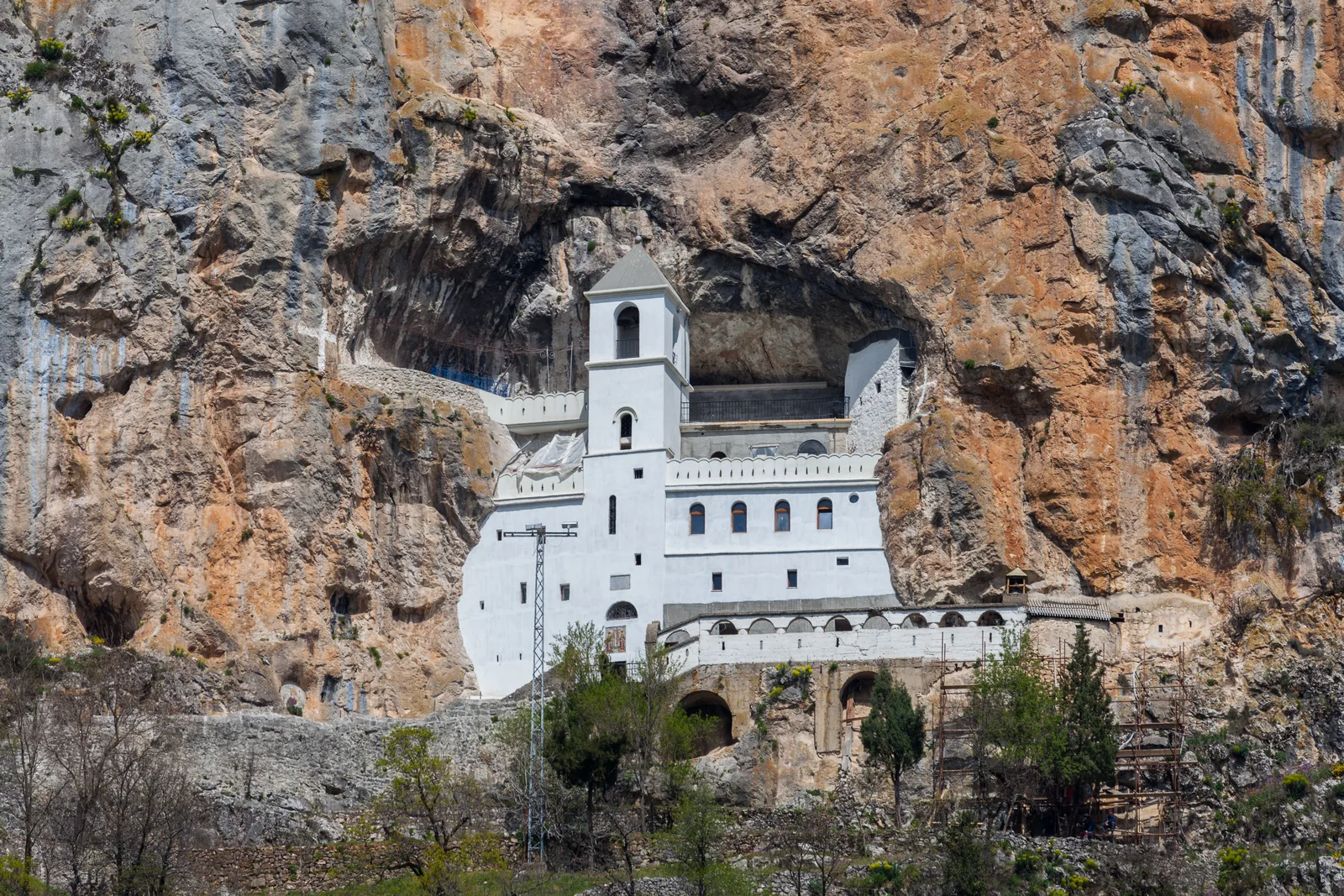
Photo: Diego Delso / Wikimedia Commons · CC BY-SA 3.0
- ✓Ostrog is Montenegro's most important Orthodox shrine — a whitewashed monastery seemingly grafted onto a sheer cliff face high above the Bjelopavlići plain, and one of the most-visited pilgrimage sites in the Balkans.
- ✓It sits well inland, roughly 100 km from Kotor, so this is a long mountain day, not a quick excursion — allow most of the day for the round trip.
- ✓There are two parts: the Lower Monastery (Donji manastir) near the road, and the dramatic Upper Monastery (Gornji manastir) built into the rock, reached by a steep road or an uphill walk that pilgrims often make on foot.
- ✓It is a living, working pilgrimage site, not a tourist attraction — modest dress and quiet, respectful behaviour are expected, and the relics of St Basil of Ostrog draw the faithful year-round.
- ✓Getting there is easiest by car or organised tour; the access road up to the Upper Monastery is narrow and busy, so many drivers park lower and walk the last stretch.
- ✓Entry to the monastery is free as a place of worship, but verify drive times, parking, any shuttle arrangement and tour prices before you go.
A monastery in the cliff
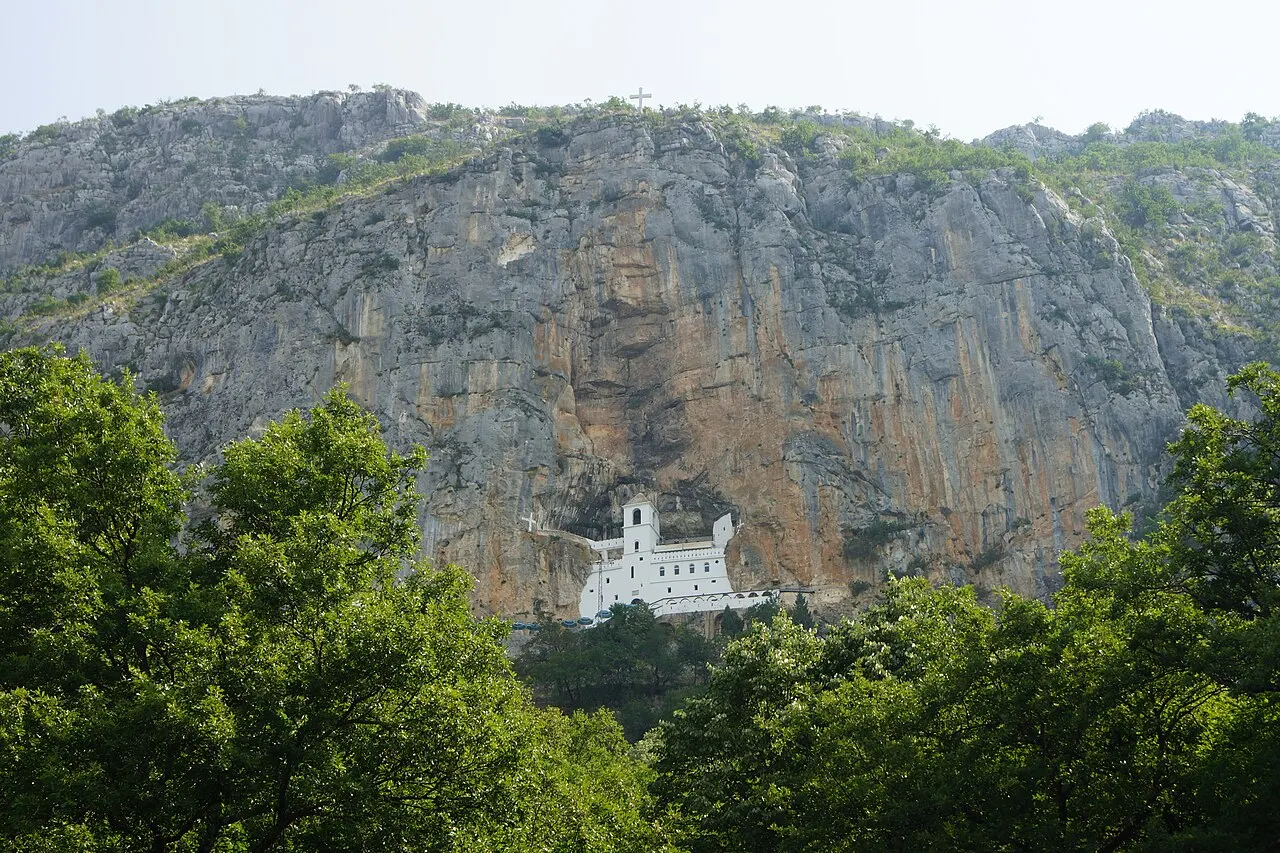
Few places in Montenegro stop you in your tracks like the first sight of Ostrog. From the valley road it looks impossible: a cluster of whitewashed walls and a small church pressed into a vertical grey cliff, hundreds of metres up, as if the rock had grown around them. Founded in the seventeenth century around St Basil of Ostrog, it is the country's most revered Orthodox shrine and one of the busiest pilgrimage sites in the whole Balkans, drawing the devout of several faiths who come to pray at the saint's relics. For the traveller, it is one of those sights that is moving even if you arrive with no faith at all — a testament to belief, stone and gravity.
Coming from the sea-and-stone world of Kotor, Ostrog is a glimpse of a different Montenegro entirely: inland, mountainous, spiritual and quiet in a way the coast never is. It is a long way to go, and the point of this guide is to be honest about that distance and clear about how to make the day work — and how to behave once you arrive, because this is first and foremost a holy place.

Getting there from Kotor
Ostrog sits inland in the mountains north of Podgorica, roughly 100 km from Kotor depending on your route — which makes it one of the longer day trips you can do from the bay. The drive climbs out of the coast, crosses the interior and approaches through the wide Bjelopavlići plain before the final ascent toward the cliff. There is no fast way to do it; budget most of a day for the round trip, and be realistic that a good chunk of it is spent on the road.
By far the simplest ways are a hire car or an organised tour. Self-driving gives you freedom over timing — and an early start beats both the heat and the busiest pilgrim hours — but the final access road up to the Upper Monastery is narrow, steep and can be heavily congested, so many drivers park at or near the Lower Monastery and walk the last section uphill, as pilgrims traditionally do. A guided day tour removes the driving and the parking puzzle entirely and often pairs Ostrog with a stop such as the old capital or a viewpoint on the way; it is the easy, hands-off choice at a fixed price per person. Public transport is impractical for a comfortable day trip. As ever, verify drive times, parking and tour prices locally — they change.
- Roughly 100 km inland from Kotor — a long mountain day, most of it on the road.
- Easiest by hire car or organised tour; public transport is impractical for a day trip.
- The access road to the Upper Monastery is narrow, steep and congested — many park lower and walk up.
- Start early to beat the heat and the busiest pilgrim hours.
- Tours often combine Ostrog with another inland stop; verify drive times and prices before you go.
 Driving in Kotor & Montenegro
Mountain roads, narrow access and rental cautions for the self-driver.
 Best Tours from Kotor
Guided day tours that handle the long drive and the cliff-road parking.
Podgorica Airport to KotorOstrog lies inland near Podgorica — handy if you are arriving from that side.
Map pins
Map data © OpenStreetMap contributors · Tiles © OpenFreeMap
The Lower and Upper monasteries
Ostrog comes in two parts, and it helps to know the difference before you arrive. The Lower Monastery (Donji manastir) sits down near the road, surrounded by trees, with a guesthouse where pilgrims stay overnight and a church with vivid frescoes — a calmer, greener place that many visitors pass through first. From here a steep road, and a traditional walking path, climbs the final couple of kilometres to the main event.
The Upper Monastery (Gornji manastir) is the one in every photograph: built directly into the cliff, its little cave-churches hewn from the living rock. This is where St Basil's relics rest, and where pilgrims queue quietly to pay their respects. Inside the rock chapels, space is tight, the light is low and the atmosphere is intense and prayerful. Take your time, keep your voice down, and understand that for many around you this is the emotional heart of a long pilgrimage, not a photo stop. The terrace outside rewards you with one of the great views in Montenegro, out over the plain to the far mountains.
- Lower Monastery (Donji manastir): greener, by the road, with frescoes and pilgrim lodging — many start here.
- Upper Monastery (Gornji manastir): the cliff-face shrine with cave-churches and St Basil's relics.
- A steep road and a walking path link the two — pilgrims traditionally walk up.
- The Upper Monastery's terrace gives a sweeping view over the Bjelopavlići plain.
Dress, respect and how to behave
This matters more at Ostrog than at almost anywhere else you will visit from Kotor, so plan for it. Ostrog is a working monastery and an active pilgrimage site, not a museum, and the same modesty expected at any Orthodox holy place applies here in full. Shoulders and knees should be covered: that means no shorts, short skirts or bare shoulders for either men or women, and women are often expected to cover their heads inside the churches. A light scarf and a layer you can throw on are worth packing even in summer heat, when the temptation to dress for the beach is strongest. Some sites keep wraps to lend, but do not rely on it.
Beyond dress, the etiquette is about quiet respect. Keep your voice low, switch your phone to silent, and follow any signs about photography — it is often restricted or forbidden inside the rock chapels, and you should never photograph people at prayer. Move gently, do not push through the queues for the relics, and remember that the people around you may have travelled far and waited long for this moment. Treated with that respect, Ostrog is one of the most affecting places in the country; treated carelessly, you simply intrude. Entry as a place of worship is free.
- Cover shoulders and knees — no shorts, short skirts or bare shoulders; women may need to cover their heads.
- Pack a light scarf and a cover-up even in summer; do not rely on borrowed wraps.
- Keep quiet, phones on silent, and respect photography restrictions inside the chapels — never photograph people praying.
- Do not push the relics queue; many around you are on pilgrimage.
- Entry is free as a place of worship — give a donation if you wish.

Day trip or overnight? An honest verdict
Is Ostrog feasible as a day trip from Kotor? Yes — many people do exactly that, by car or on a tour — but go in clear-eyed about the distance. With roughly 100 km each way over mountain roads, most of your day is travel, and you will likely have an hour or two at the monastery itself rather than a leisurely afternoon. That is enough to take in both monasteries and the view, and for most visitors it is the right call: see it, be moved by it, and be home in the bay by evening. Starting early is the key to making it comfortable rather than rushed.
Two alternatives are worth knowing. Pilgrims and some travellers stay overnight at the Lower Monastery's simple lodging, which lets you experience the dawn services and the quiet before the day's crowds — a profound option if the spiritual side draws you. And because Ostrog sits inland, it slots neatly into a longer northern or central-Montenegro loop rather than a single out-and-back: combined with the canyons or the old capital, it makes a richer multi-stop itinerary. For a first visit, though, the honest steer is simple — a long but rewarding day trip, taken early and treated with respect.
- Day trip: feasible and common, but it is a long mountain drive — start early to keep it comfortable.
- Expect an hour or two at the monastery, enough for both sites and the view.
- Overnight pilgrim lodging at the Lower Monastery suits those drawn to the dawn services.
- Ostrog also folds neatly into a longer northern or central-Montenegro loop.

Ostrog Monastery at a glance
Use this card to set expectations and prepare for a respectful visit. The cliff setting, the two monasteries, the pilgrimage status and the dress expectations are evergreen; the volatile details — exact drive times, parking and any shuttle, opening hours and tour prices — change, so verify them from official and operator sources before you rely on them. Entry to the monastery is free, but a donation is welcome.
- What it is: Montenegro's most important Orthodox shrine, a cliff-face monastery and major pilgrimage site.
- Distance from Kotor: roughly 100 km inland — a long mountain day, mostly on the road.
- Two parts: the Lower Monastery by the road and the Upper Monastery in the cliff.
- Dress code: cover shoulders and knees; women may need a head covering; quiet, respectful conduct throughout.
- Getting there: easiest by car or guided tour; the cliff access road is narrow and busy.
- Verify locally: drive times, parking/shuttle, visiting hours and tour prices. Entry is free as a place of worship.
Best Day Trips from Kotor
The hub for day trips from Kotor: the bay classics of Perast and Tivat, the mountain day to Lovćen and Cetinje, the coast at Budva, Sveti Stefan and Herceg Novi, cross-border Dubrovnik, and the inland wonders of Skadar Lake, Ostrog and Durmitor.
Read guidePodgorica Airport to Kotor
How to get from Podgorica Airport (TGD) to Kotor: pre-booked private transfer, rental car with route notes, or the airport-and-intercity-bus route — with realistic timing cautions and a FAQ.
Read guide
Northern Montenegro Day Tours from Kotor
Compare the big long-day tours from Kotor into the wild north and interior: Durmitor and the Black Lake, the Tara Canyon and rafting, Ostrog Monastery, Lake Skadar and the combined 'north in a day' loops — how to pick the right one, and when an overnight beats the long day.
Read guideMore in Day Trips
6
Bar & Ulcinj Day Trip from Kotor
When Montenegro's far southern coast is worth the long drive from Kotor: Old Bar's ruined hill town and ancient olives, Bar's port, Ulcinj's walled quarter and the great sand of Velika Plaža and Ada Bojana — plus the tradeoffs.
Read guide
Budva Day Trip from Kotor
How to do Budva as a day trip from Kotor: the short coast drive, the bus and tour options, the walled Old Town, the riviera beaches and nightlife, and an honest verdict on how long Budva really needs.
Read guide
Cetinje Day Trip from Kotor
How to day-trip from Kotor to Cetinje, Montenegro's old royal capital: getting there over Lovćen or by the faster road, the royal palace and museums, the Cetinje Monastery and its relics, the old embassies, and pairing the visit with Lovćen — with planning notes.
Read guide
Dubrovnik Day Trip from Kotor
Making Dubrovnik a day trip from Kotor: the cross-border distance, the two crossings and their summer queues, tour versus self-drive, how the day shapes up, and an honest verdict on when it is simply too ambitious.
Read guide
Durmitor Day Trip from Kotor
How to reach Durmitor National Park and the Black Lake from Kotor: the long drive north, what the park holds, the season, getting there by car or tour, and the honest day-trip-versus-overnight tradeoff for Montenegro's high mountains.
Read guide
Herceg Novi Day Trip from Kotor
How to do Herceg Novi as a day trip from Kotor: the drive with the Kamenari–Lepetane ferry shortcut, the stepped Old Town and its fortresses, the long seafront promenade and beaches, and when Herceg Novi beats Budva.
Read guide