
Boka Navy Traditions in Kotor
A guide to the Boka Navy (Bokeljska Mornarica) of Kotor — one of the world's oldest maritime confraternities, its ties to St Tryphon and the 3 February feast, the ceremonial kolo round dance before the cathedral, and the gold-braided historic uniforms, plus how to witness it and where it fits in a Kotor stay.

Photo: Fatih Beki / Unsplash
- ✓The Boka Navy (Bokeljska Mornarica) is one of the world's oldest surviving maritime fraternities — a guild of Kotor's sailors and captains traditionally dated back more than twelve centuries.
- ✓Its identity is woven into Kotor's patron, St Tryphon, whose relics the town has guarded since 809; the navy's biggest day falls on the saint's feast, the Tripundanska / St Tryphon festivities around 3 February.
- ✓The signature sight is the ceremonial kolo — a slow, formal round dance the navy performs in full historic dress before St Tryphon Cathedral.
- ✓Those uniforms are the spectacle in themselves: dark gold-braided coats, sashes, swords and tasselled caps, worn with centuries of pride.
- ✓The Boka Navy's skills and rituals are recognised by UNESCO on its list of intangible cultural heritage in need of safeguarding — this is living tradition, not a staged tourist show.
- ✓Exact ceremony dates, the order of the procession and any museum opening times shift year to year — verify the current St Tryphon festivities programme before you build a day around it.
What the Boka Navy is
The Boka Navy — Bokeljska Mornarica in Montenegrin — is not a military fleet but a confraternity: an ancient brotherhood of the seafarers of the Bay of Kotor, the captains, sailors and shipwrights whose trade made this small walled town a Mediterranean maritime power far out of proportion to its size. By tradition the fraternity reaches back to the early ninth century, which would make it one of the oldest organisations of its kind still active anywhere in the world. For most of its history it bound the bay's sailors together for mutual aid, religious devotion and the defence of their port, and it never quite stopped — today it survives as a ceremonial and cultural body that carries those rituals into the present.
To understand the Boka Navy is to understand why Kotor feels the way it does. This is a town that looked outward to the sea for its wealth and its identity, and the confraternity is the human thread that ties the merchant's palaces, the maritime museum's models and the cathedral's treasury into one story. Seeing the navy in its full dress before the cathedral is the closest you can come to watching that story step out of the museum and into the square.
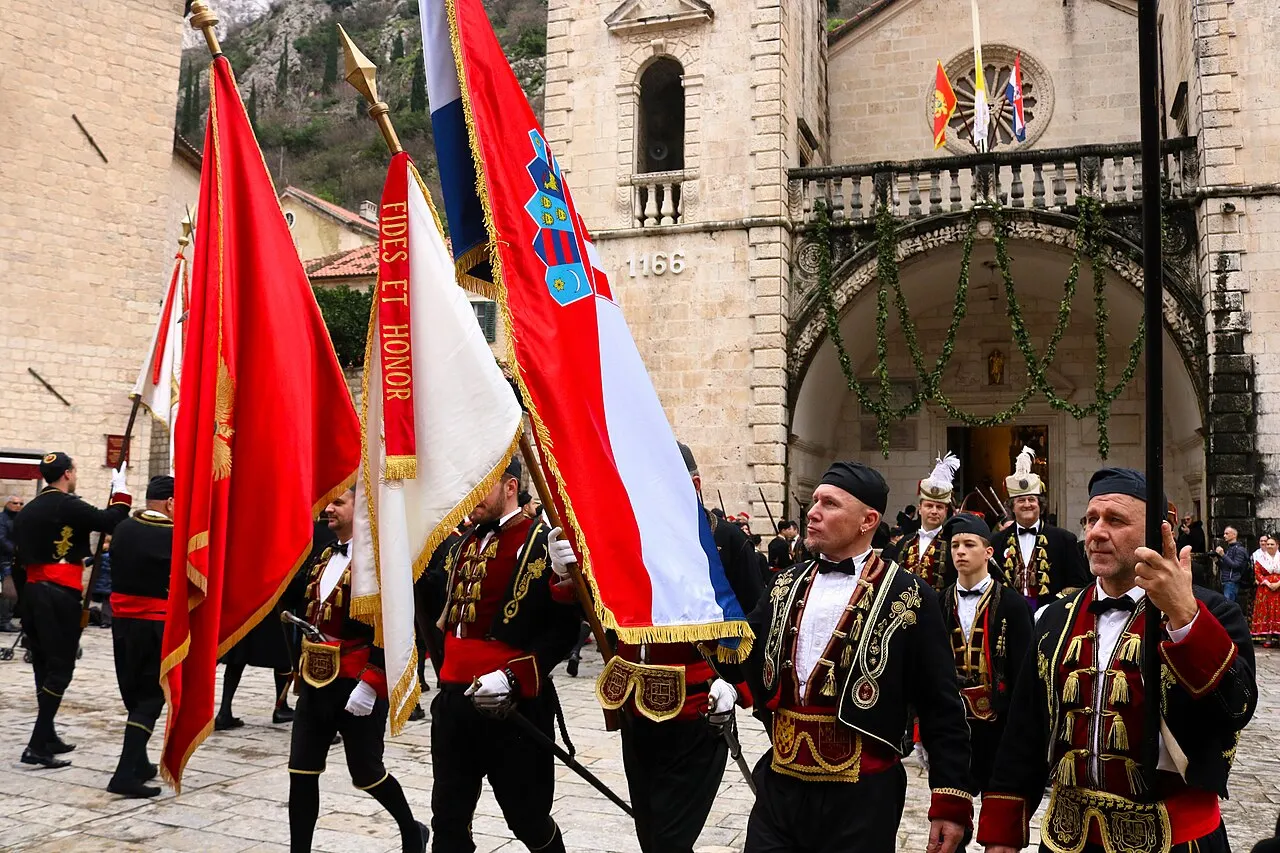
St Tryphon and the feast of 3 February
The navy's calendar turns around one date: the feast of St Tryphon, Kotor's patron saint, on 3 February. The bond is old and literal — the town has guarded the saint's relics since 809, the same era from which the confraternity dates itself, and the cathedral raised to house those relics, consecrated in 1166, stands at the heart of the celebrations. The days around the feast, known locally as Tripundanske svečanosti, the St Tryphon festivities, are when Kotor turns its civic and religious life inside out into the open squares, and when the Boka Navy is most visible.
Expect a sequence of solemn and joyful moments spread across the festive period: the lowering and veneration of the saint's relics, processions through the Old Town, a sung Mass in the cathedral, and the navy's own ceremonies in the square outside. It is a deeply local occasion — winter, off-season, with the cruise crowds long gone — which is exactly its charm. You are watching a town keep faith with its own past, not performing for visitors, and February's quiet, lamplit Kotor is a beautiful and underrated time to be here.
- St Tryphon, Kotor's patron, has his feast on 3 February; the celebrations spread across the surrounding days.
- The town has held the saint's relics since 809 and built the cathedral, consecrated in 1166, to house them.
- This is a winter, off-season event — quiet, local and atmospheric, far from the summer crowds.
- Verify the current year's festivities programme and the timing of each ceremony before you travel for it.
 St Tryphon Cathedral
The 1166 Romanesque cathedral and treasury at the centre of the saint's feast.
 Kotor in February
What the bay is like in the festive off-season month — quiet lanes, cool weather, low prices.
Map pins
Map data © OpenStreetMap contributors · Tiles © OpenFreeMap
The kolo, the uniforms and the spectacle
The single image most people carry away from a Boka Navy ceremony is the kolo — a slow, formal round dance the confraternity performs in the square before St Tryphon Cathedral. It is not folk dancing for entertainment but a ritual: ranks of men in full ceremonial dress, moving in a measured circle to the beat of their own commands, swords drawn, in a choreography handed down for generations. Watching it, you feel the weight of every year behind it.
And then there is the dress. The Boka Navy's historic uniform is unmistakable — dark coats heavy with gold braid, broad sashes, tasselled caps, decorations and ceremonial swords, worn with absolute seriousness. The detail is the point: each thread carries rank and history, and the sight of the full company assembled in the grey winter light, with the floodlit ramparts climbing the cliff behind them, is one of the most photogenic and moving things you can witness in Kotor. UNESCO recognises the navy's skills and rituals as intangible cultural heritage in need of safeguarding, which is the surest sign that what you are seeing is the real, fragile, living thing.
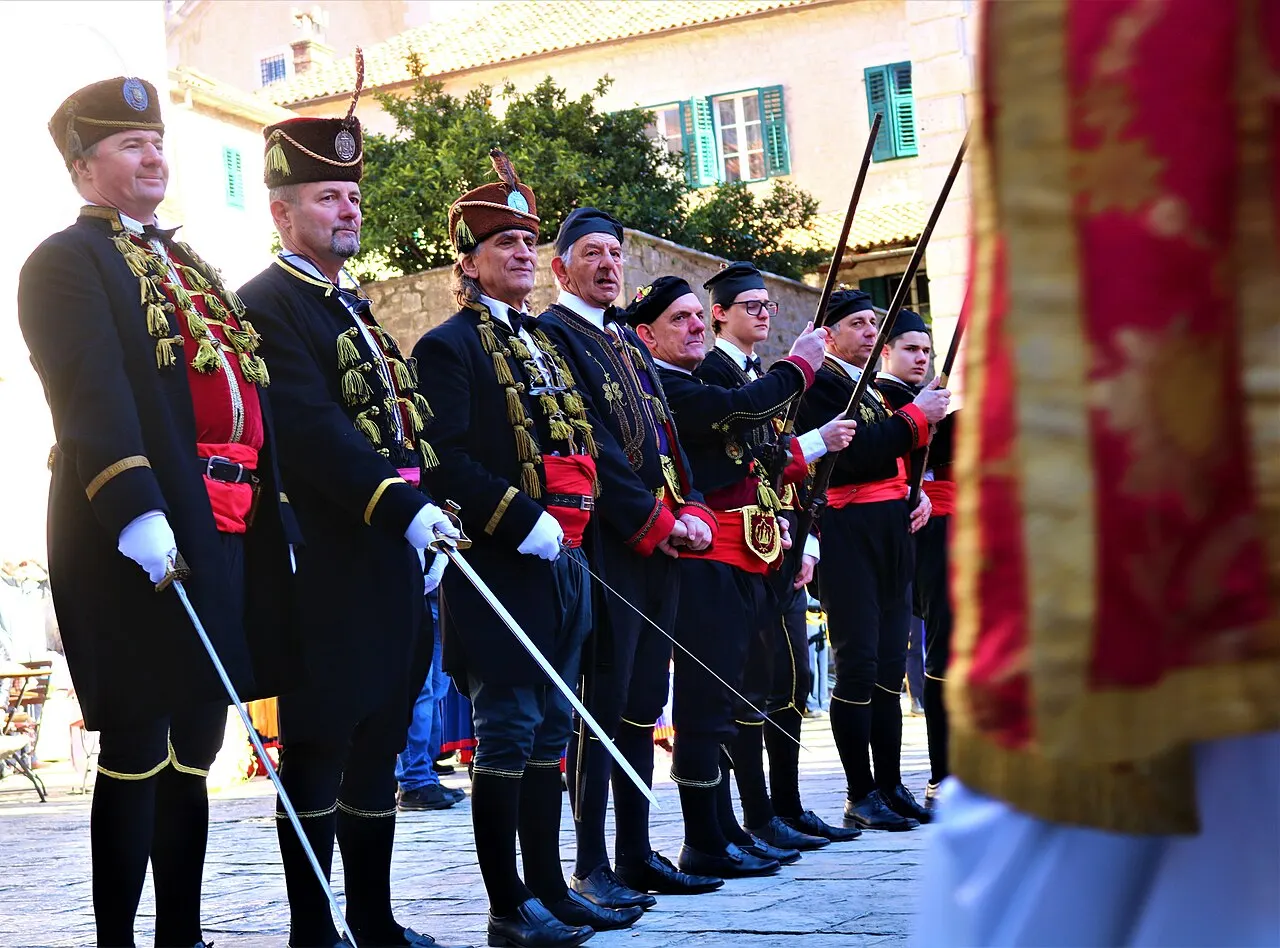
- The kolo is a slow, formal ceremonial round dance performed by the navy before the cathedral — ritual, not entertainment.
- The historic uniform — gold braid, sashes, swords, tasselled caps — is itself the spectacle; every detail carries rank and history.
- UNESCO lists the navy's skills among intangible cultural heritage in need of safeguarding.
- Photograph respectfully and keep clear of the procession lines — this is a living ritual, not a staged show.

How to witness it, and where to stay
If you want to see the Boka Navy in full ceremony, plan around the St Tryphon festivities in early February rather than hoping to catch them by chance — the confraternity also appears at certain other civic and religious occasions through the year, but the feast of the patron is the great set piece. Because this is winter, off-season, the practicalities are easy: rooms are widely available and far cheaper than in summer, the Old Town is calm, and you can usually walk straight to the cathedral square. The catch is the weather — Kotor is among the wettest towns in Europe in winter, so pack for rain and dress warmly for standing outdoors during the ceremonies.
Stay inside or just outside the walls so you can reach the square on foot and duck back to warmth between ceremonies; in February there is no advantage to a far-flung base. Arrive early on the day of the main rites to find a good vantage point before the square fills, and leave the exact running order as something to confirm locally — the cathedral, the tourist office and the navy's own announcements are the place to check this year's programme. Round the day off the way Kotor does best: a long, late dinner in a warm konoba a lane or two off the square, the bay's seafood and a glass of Vranac, the winter dark settling over the emptied lanes outside.
- Time your visit to the early-February St Tryphon festivities for the full ceremony — the feast is the main event.
- Off-season means easy, cheap rooms and calm lanes; stay near the walls and walk to the square.
- Dress for cold and rain — Kotor's winters are wet, and the ceremonies are outdoors.
- Confirm this year's running order with the cathedral and tourist office; end the day with a late dinner off the square.


Kotor Events Calendar
The year-round guide to Kotor's festivals and traditions: the winter and summer Carnivals, the KotorArt summer festival, the great Bokeljska Noć on the bay, the Fašinada at Perast, the Boka Navy's St Tryphon traditions, and the festive season.
Read guide
A Traveler's History of Kotor
A traveler-friendly primer on Kotor's history before you walk the town: Illyrian and Roman roots, Byzantine and Serbian rule, four centuries under Venice, the bay's seafaring fortunes, earthquakes, the world wars and UNESCO protection.
Read guideMaritime Museum of Montenegro, Kotor
Inside Kotor's Maritime Museum of Montenegro: the baroque Grgurina Palace, three floors of ships, captains' portraits, maps, weapons and Boka seafaring history — and why it is the Old Town's best rainy-day visit.
Read guideMore in Events
6
Bokeljska Noć (Boka Night)
A guide to Bokeljska Noć — Kotor's late-summer festival of decorated, illuminated boats on the bay, closing with fireworks over the water — including where to stand, the waterfront crowds and where to stay.
Read guide
Camellia Days in Stoliv
A guide to Camellia Days (Praznik kamelija) in Stoliv — the quiet Vrmac-shore village that is the Bay of Kotor's camellia heart, a flower the captains brought home from the Far East and now a symbol of the Boka, celebrated each spring with blooms, a camellia ball and gentle bay walks, plus how to fold it into a Kotor stay.
Read guideChristmas & New Year in Kotor
What Christmas and New Year are like in Kotor — a quiet, lamplit, often wet off-season Old Town with festive lights and a New Year's Eve celebration on the squares, hearty winter food and the calm the summer never offers.
Read guideFašinada in Perast
A guide to the Fašinada — Perast's centuries-old tradition, held every 22 July, when at dusk a procession of boats rows out to Our Lady of the Rocks and drops stones to reinforce the island — with its legend, timing and how to watch respectfully.
Read guideKotor Carnival Guide
A planning guide to Kotor's Carnival in both its forms — the centuries-old winter Carnival of masks and parades through the off-season Old Town, and the summer Carnival in the warm months: what to expect, when each falls, hotel timing and crowds.
Read guideKotor Children's Theatre Festival
A family guide to Kotor's international children's theatre festival — a long-running summer fixture that fills the Old Town's squares with puppetry, street theatre, shows and a children's parade — with how to find the programme, when shows run, ticket and free-event tips, and where to stay with kids.
Read guide