
St Tryphon Cathedral, Kotor
How to visit Kotor's landmark Romanesque cathedral, consecrated in 1166: the twin bell towers, the treasury and the relics of St Tryphon, the art, the square, and the Old Town heritage that surrounds it.

Photo: Ivana Djudic / Unsplash
- ✓St Tryphon's is one of the oldest cathedrals on the Adriatic, consecrated in 1166 and dedicated to the city's patron saint.
- ✓Its two bell towers frame the most photographed facade in Kotor — though they are deliberately mismatched, never rebuilt to match after the great 1667 earthquake.
- ✓The treasury holds a remarkable collection of reliquaries and Gothic-Renaissance gold-and-silverwork, including relics of St Tryphon himself.
- ✓Inside, a 14th-century stone ciborium over the altar and fragments of medieval frescoes are the artistic highlights.
- ✓Every 3 February the city celebrates its patron with the Tripundanske svečanosti — the feast of St Tryphon, Kotor's oldest tradition.
Kotor's defining building
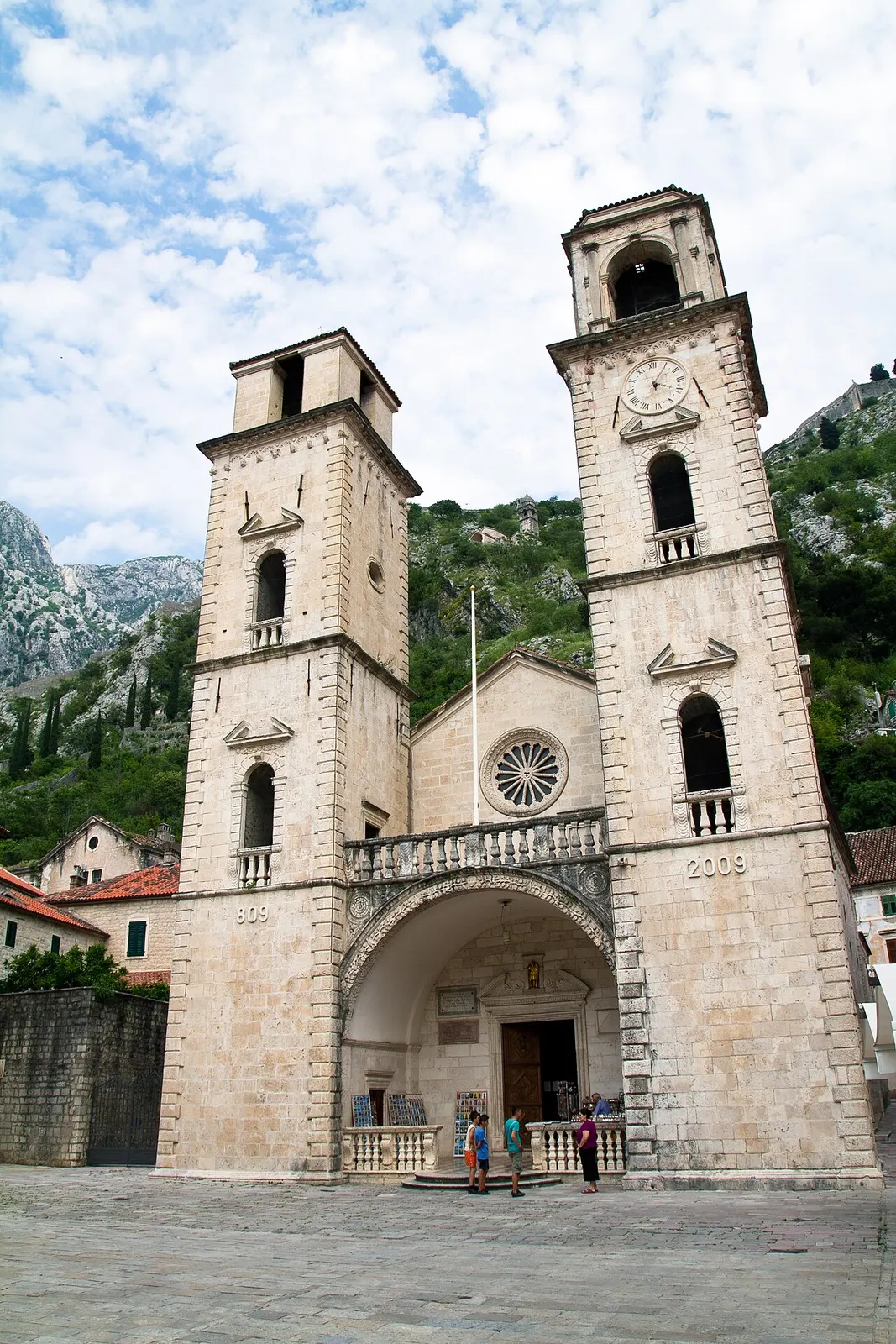
If the city walls are Kotor's defining height, the Cathedral of St Tryphon is its defining building — the heart from which the whole Old Town radiates. Stand on St Tryphon Square and look up at the broad, pale Romanesque facade flanked by its two bell towers, and you are looking at the image that has represented this town for the better part of nine centuries. It is older than almost anything around it, and everything around it has, in a sense, grown up against it.
The cathedral was consecrated in 1166, making it one of the oldest on the eastern Adriatic, built on the site of an earlier church that already held the relics of the saint. It is dedicated to St Tryphon (Sveti Tripun), Kotor's patron, whose remains were said to have been brought to the city in the early 9th century — the tradition dates the original church's founding to 809. That long continuity is the point: this is not a museum-piece church but the living centre of a Catholic community that has worshipped here without a break for over a thousand years.
The mismatched towers and the earthquakes
Look closely at the two bell towers and you will notice they do not quite match — and that asymmetry is the cathedral's most honest detail. Kotor sits on an active seismic zone, and the great earthquake of 6 April 1667 wrecked much of the city, the cathedral included. When the towers were rebuilt, the work was done as funds allowed rather than to a single design, leaving the facade with the slightly off-balance silhouette it keeps today. Earlier and later quakes, the major one of 1979 among them, each left their mark and their repairs.
Rather than a flaw, the locals read this as the building's life story written in stone. The Romanesque core, the baroque-era reconstruction, the patient restorations after each disaster — they are all visible at once, layered into one facade. It makes St Tryphon's a more interesting thing to look at than a perfectly symmetrical church would ever be, and a vivid lesson in how this whole town has been knocked down and lovingly rebuilt, again and again.

Map pins
Map data © OpenStreetMap contributors · Tiles © OpenFreeMap
Inside: the treasury, the relics and the art
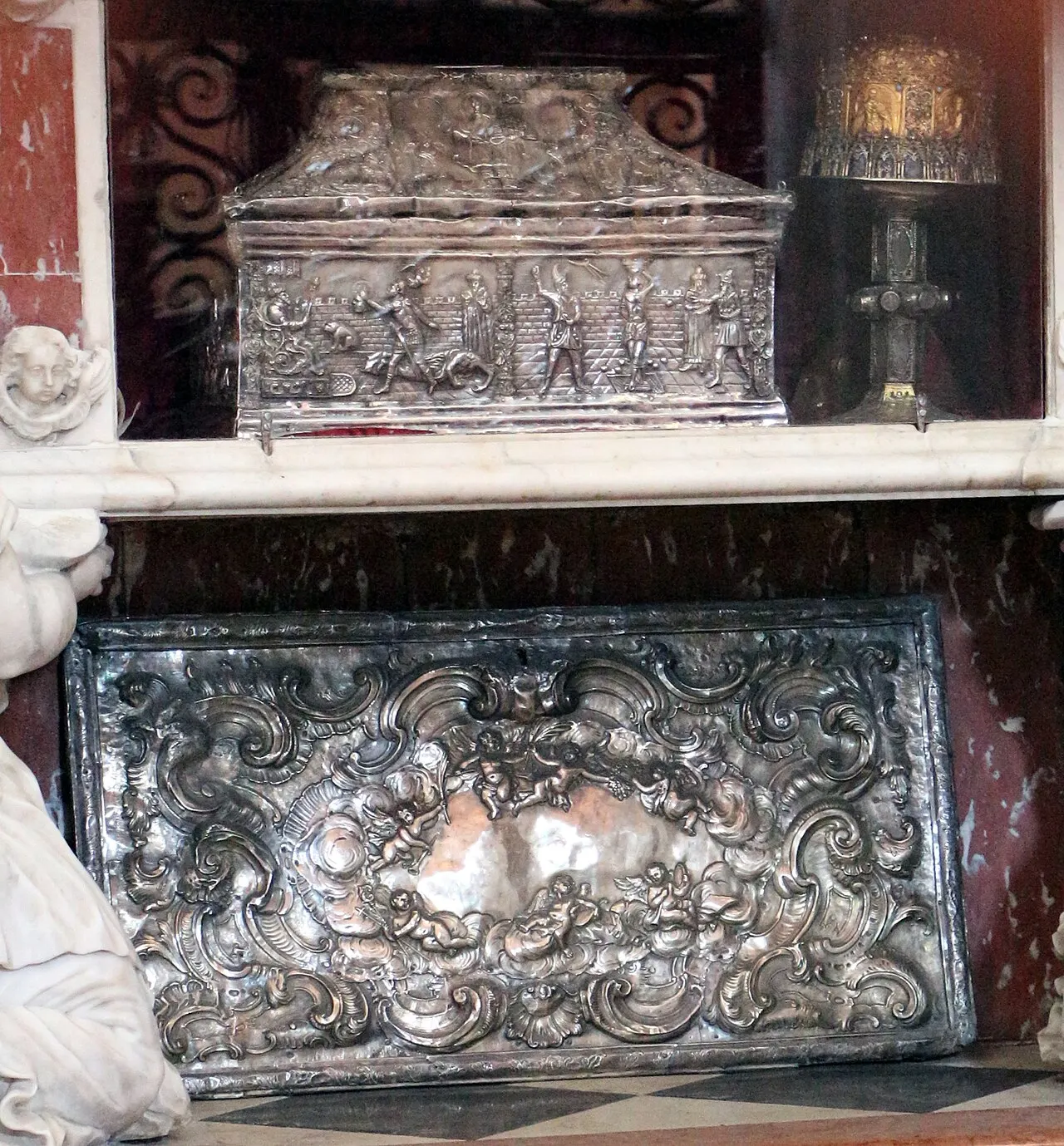
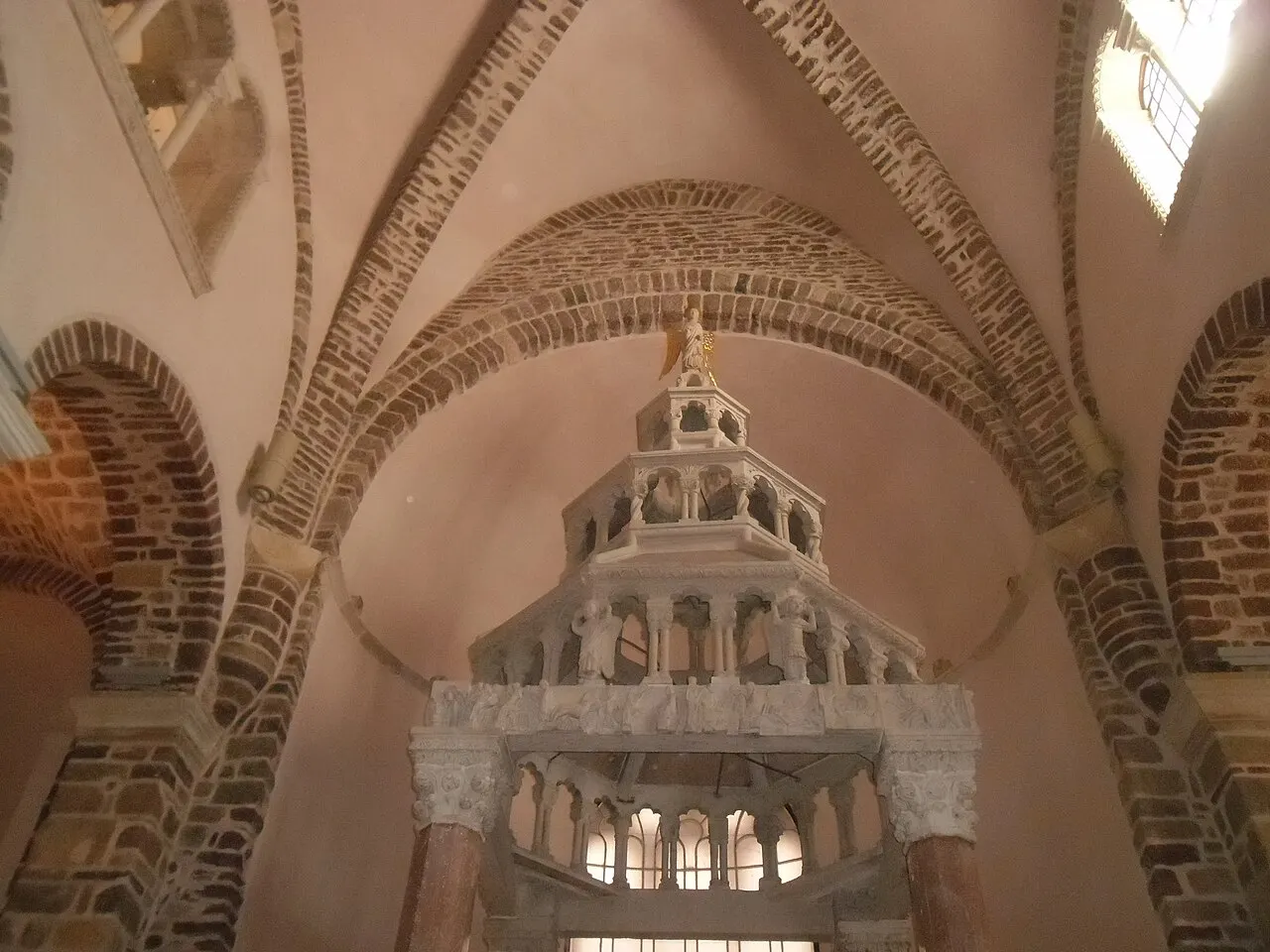
Step through the door and the interior is calmer and plainer than the facade suggests — solid Romanesque arches, a sense of great age, and the soft light that suits a working church. The artistic centrepiece is the 14th-century stone ciborium, a canopy on slender columns rising over the main altar, carved with biblical scenes; it is one of the finest pieces of medieval stonework on the coast. Around it, fragments of old frescoes survive on the walls, ghostly remnants of how the whole interior once looked.
The real treasure, though, is upstairs in the reliquary chapel and treasury. Here Kotor keeps centuries of accumulated devotion: gilded reliquaries, a celebrated silver-and-gold altar screen, and a collection of liturgical objects spanning Gothic to Renaissance and baroque craftsmanship, much of it the work of Kotor's own renowned goldsmiths. Among them are reliquaries said to hold the head and bones of St Tryphon himself — the very relics around which the whole cathedral was built.
Give the treasury time; it is easy to rush the nave and miss the room that justifies the visit. The combination of the stonework below and the goldwork above is what makes St Tryphon's more than a pretty facade — it is a small, dense museum of a thousand years of Boka faith and craft.
- Don't miss: the 14th-century stone ciborium over the altar and the surviving fresco fragments.
- The upstairs treasury holds reliquaries, an ornate altar screen and relics of St Tryphon — the highlight of the visit.
- An entry ticket usually applies and typically includes the treasury — verify the current price and opening hours before you go.
St Tryphon Square and the feast day
The square in front of the cathedral, Trg Svetog Tripuna, is one of the loveliest open spaces in the Old Town — a stage framed by the facade on one side and old stone palaces on the others, ringed by café tables. It is a fine place to sit with a coffee and simply take in the building, especially in the early morning or evening when the day's crowds thin and the warm stone glows. The square is free and always open; the pleasure of the facade costs nothing.
The cathedral comes most alive on 3 February, the feast of St Tryphon, the focus of the Tripundanske svečanosti — celebrations that the people of Kotor have kept for over twelve centuries, among the oldest continuous traditions in the region. The Boka Navy, the ceremonial mariners' guild in their historic uniforms, perform their slow circular kolo dance before the cathedral, and the relics are carried in procession. If your visit falls in early February, it is an extraordinary thing to witness; if it does not, the year-round building is reward enough.


Who was St Tryphon, and the story of the relics
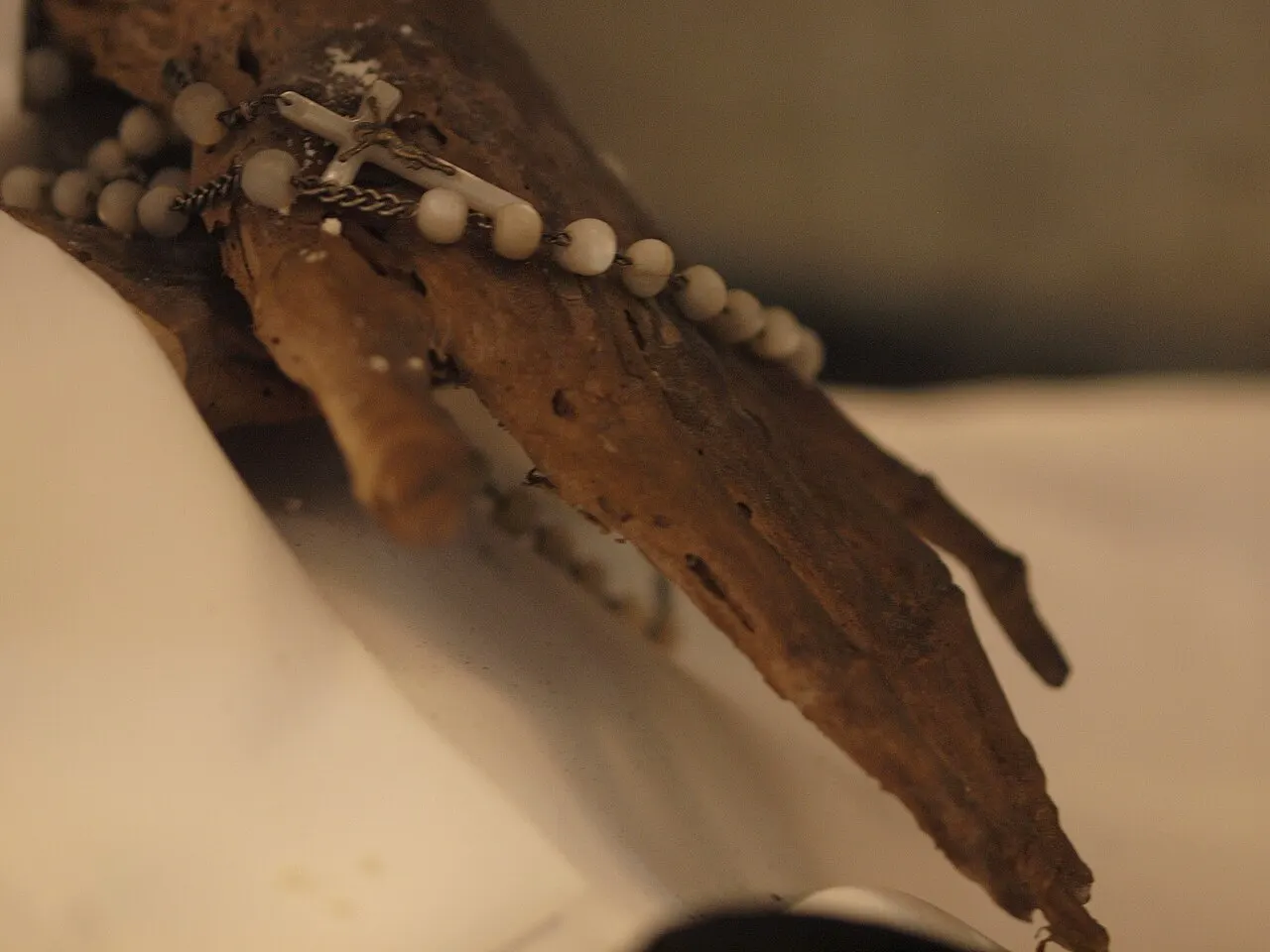
It is worth knowing the saint the whole building exists for, because his story is woven through the town's identity. Tryphon was an early Christian martyr from Asia Minor, by tradition a young man martyred in the 3rd century, venerated across both the Eastern and Western churches. Kotor's connection to him rests on a much-loved legend: that in the year 809 a Venetian merchant ship carrying the saint's relics sheltered in the bay, and when it tried to leave, contrary winds and storms kept it in port until the people of Kotor bought the relics and built a church to house them. Whether history or pious tale, that founding moment is the root of everything — the cathedral, the patronage, the twelve centuries of devotion.
From that point Tryphon became Kotor's heavenly protector, the saint to whom the city's sailors prayed for safe passage and to whom it gave thanks for survival through earthquakes, sieges and plagues. His image and his cross appear across the Old Town, and his relics — kept in the treasury upstairs — remain the cathedral's most sacred possession, carried in procession on his feast. Understanding that the building is, at heart, a reliquary grown into a cathedral changes how you see it: the great Romanesque shell is essentially the elaborate housing the city built, and kept rebuilding after every quake, to keep its patron close.
- St Tryphon was an early Christian martyr venerated in both the Eastern and Western churches.
- By legend, a ship carrying his relics sheltered in the bay in 809 and Kotor bought them and built a church.
- He became the city's patron and protector of its sailors; his relics are the treasury's holiest objects.
- The cathedral is, in essence, a reliquary grown into a great church — and rebuilt after every earthquake.
Common questions
A few questions come up again and again, so here are the short answers. Is there an entry fee? A ticket commonly applies for sightseeing visits and usually includes the treasury upstairs, which is the part most worth your money; verify the current price and hours, which change with the season and services. How long does a visit take? Around half an hour does the building justice, longer if the treasury and the ciborium draw you in. Can I go inside if a service is on? Worshippers are always welcome, but sightseeing pauses during services — stand respectfully at the back or come back later.
What should I wear? Modest dress with shoulders and knees covered, as in any active Catholic church. Can I take photos? Photography may be limited, especially in the treasury, so check the posted signs and any staff guidance rather than assume. When is it quietest? Early in the morning, before the cruise groups arrive, when you may have the great Romanesque nave almost to yourself — which is also the best light on the square outside. And when is it busiest and most special? Around 3 February, the feast of St Tryphon, when the celebrations and processions fill the square. As with all volatile details, confirm the ticket, the hours and any feast-day arrangements on the day.
Visiting respectfully: practical notes
St Tryphon's is an active Roman Catholic cathedral, so visit as a guest of a living church. Dress modestly — covered shoulders and knees are expected — keep your voice low, and step back if a service is in progress. Photography rules vary and may be restricted, especially in the treasury, so look for posted signs and follow any guidance from staff. An entry ticket commonly applies for sightseeing visits and usually includes access to the treasury, while those coming to pray are a separate matter; verify the current arrangements, price and hours on the day, as they change with the season.
On timing, the cathedral fits naturally early in an Old Town wander, while the lanes are still cool and quiet. It is a few minutes' walk from the Sea Gate and the Clock Tower, and an easy pairing with St Luke's and St Nicholas's churches a couple of squares away, or with the Maritime Museum. Half an hour does the building justice; longer if the treasury draws you in. Come before the cruise groups arrive, and you may have the great Romanesque nave almost to yourself.
- Dress modestly (shoulders and knees covered); it is a working cathedral, not just a sight.
- Photography may be limited, especially in the treasury — check posted signs and staff guidance.
- Verify entry price and opening hours on the day; visit early to beat the cruise-day crowds.

A Self-Guided Walk Through Kotor's Old Town
A self-guided walking route through Kotor's Old Town: the Sea Gate, Arms Square and the clock tower, St Tryphon Cathedral, St Luke's and St Nicholas, the maze of palaces and the wall-view corners — in the right order, at the right hour.
Read guide
St Luke's Church, Kotor
A guide to one of Kotor's most atmospheric small churches: St Luke's (Sveti Luka), built in 1195, famous for the rare period when it held both a Catholic and an Orthodox altar — and the quiet square it shares with St Nicholas's.
Read guide
A Traveler's History of Kotor
A traveler-friendly primer on Kotor's history before you walk the town: Illyrian and Roman roots, Byzantine and Serbian rule, four centuries under Venice, the bay's seafaring fortunes, earthquakes, the world wars and UNESCO protection.
Read guideMore in Old Town
4Clock Tower & Arms Square, Kotor
The Clock Tower on Arms Square is the first thing you meet inside Kotor's Sea Gate — the Old Town's natural anchor for orientation, cafés, routes and meeting up. How to use it, what to see around it, and the leaning landmark's story.
Read guideKotor Sea Gate
Start your Old Town visit at the Sea Gate — Kotor's main western gate of 1555, opening from the waterfront onto Arms Square and the leaning clock tower. Where to find it from the cruise port, what to look for, and how to plan a route through the squares.
Read guideMaritime Museum of Montenegro, Kotor
Inside Kotor's Maritime Museum of Montenegro: the baroque Grgurina Palace, three floors of ships, captains' portraits, maps, weapons and Boka seafaring history — and why it is the Old Town's best rainy-day visit.
Read guide
St Nicholas's Church, Kotor
A respectful visitor guide to Kotor's main Serbian Orthodox church: St Nicholas's (Sveti Nikola), the twin-towered early-20th-century church on St Luke's Square, its glowing icons and silverwork, and how to visit.
Read guide