
Clock Tower & Arms Square, Kotor
The Clock Tower on Arms Square is the first thing you meet inside Kotor's Sea Gate — the Old Town's natural anchor for orientation, cafés, routes and meeting up. How to use it, what to see around it, and the leaning landmark's story.

Photo: Fatih Beki / Unsplash
- ✓The Clock Tower stands on Arms Square (Trg od oružja), the largest square in the Old Town and the first space you enter through the main Sea Gate.
- ✓It dates from the early 17th century, raised under Venetian rule, and famously leans — the masonry visibly tilts, a quirk locals are quietly fond of.
- ✓Arms Square is Kotor's living room: cafés spill across the flagstones, the squares-not-streets layout fans out from here, and it is where everyone agrees to meet.
- ✓A short stone pillar beside the tower — the old 'pillar of shame' (sramotni stub) — once held wrongdoers up to public ridicule.
- ✓Use it as your zero point: from the tower, St Tryphon Cathedral, the Maritime Museum and the walls climb are all a few minutes' walk.
Your first landmark inside the walls
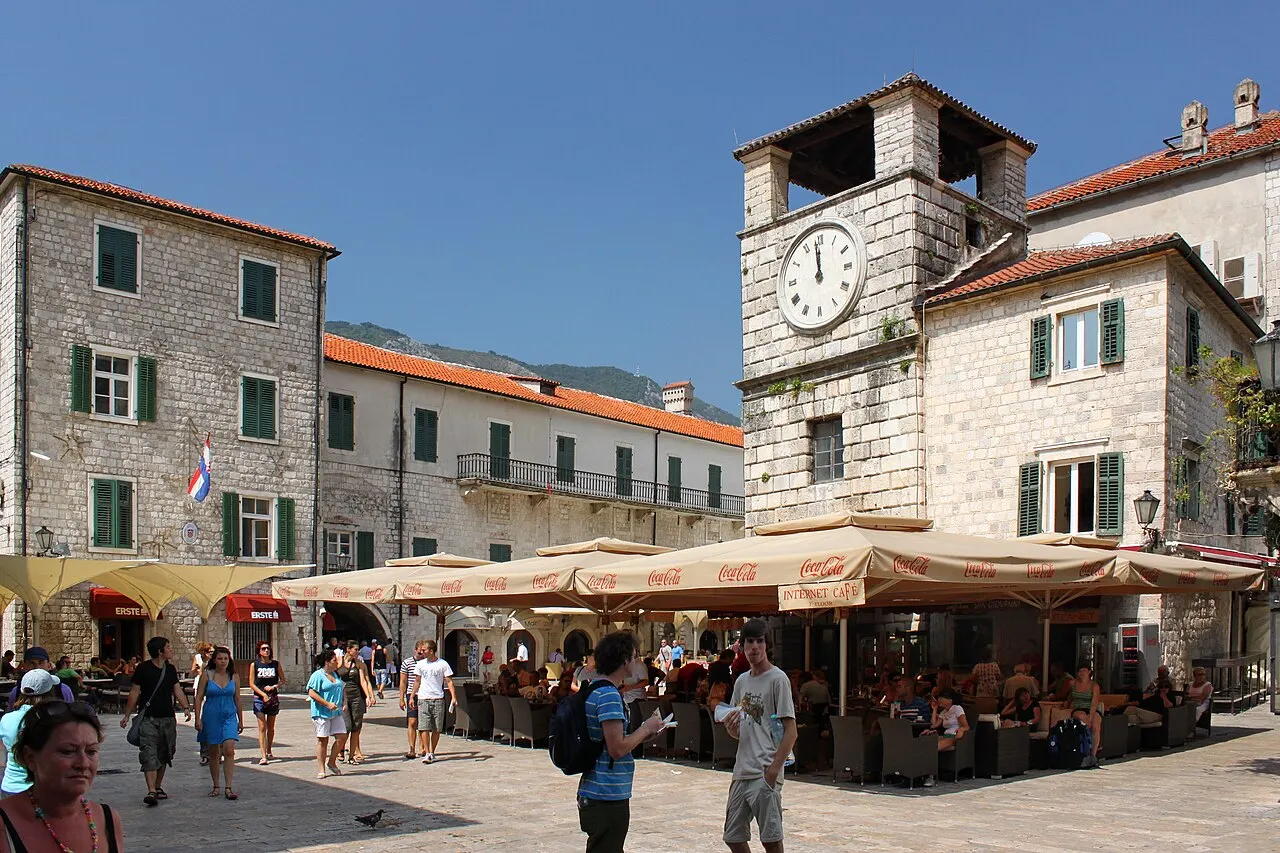
Walk in through Kotor's main Sea Gate — the grand western entrance of 1555 that faces the quay and the cruise berth — and the Old Town opens straight onto Arms Square, with the Clock Tower rising at the far side. It is the first thing almost everyone sees inside the walls, and that makes it the single most useful object in town: a fixed, visible point you can navigate back to from anywhere in the maze of lanes.
Kotor is a town that navigates by squares rather than street names, and Arms Square (Trg od oružja) is the biggest of them. From this one open space the lanes radiate toward Flour Square, St Tryphon Square, St Luke's Square and the gate at the back where the wall-walk begins. Get your bearings here first, then let yourself get lost — you are never more than a few turns from finding the tower again.
The leaning tower and its story
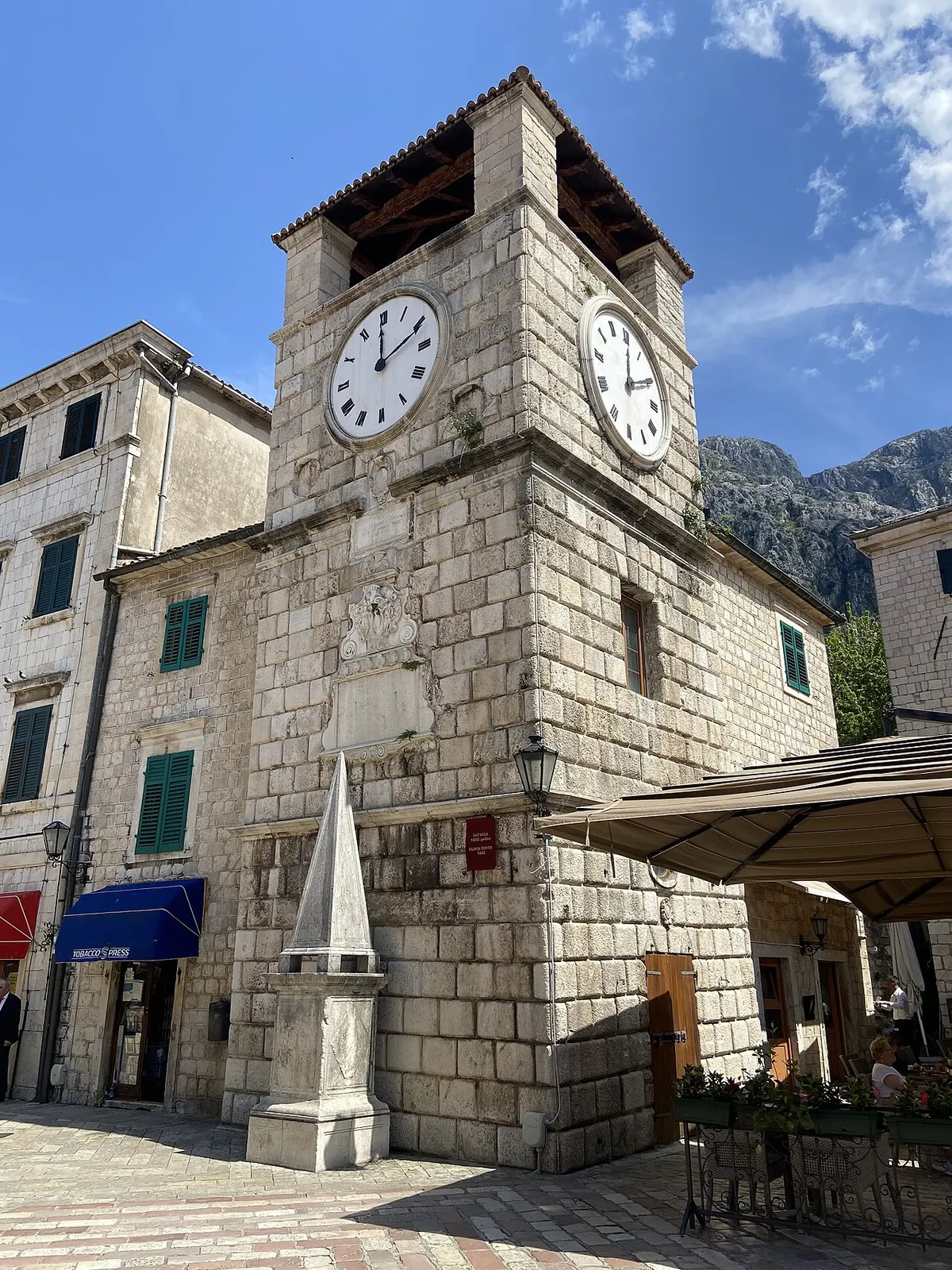
The Clock Tower was raised in the early 17th century, in the long centuries when Kotor belonged to the Venetian Republic, and it has kept watch over the square ever since. It is a slim stone tower with a clock face high on its front, topped by a small bell stage — modest in scale, but unmistakable as the visual full-stop at the end of the square.
Its most-photographed quirk is the lean. The tower visibly tilts off true, the legacy of the earthquakes that have repeatedly shaken the bay over the centuries — the catastrophic quake of 1667 and the major one of 1979 among them. Restoration has stabilised it, but the tilt remains, and locals would not have it straightened: a leaning clock tower is exactly the kind of imperfection a 900-year-old port town wears proudly.
At the tower's base stands a short, pyramid-topped stone pillar. This is the old 'pillar of shame' (sramotni stub), where, in earlier centuries, those who had broken the town's laws were chained and exposed to the ridicule of passers-by. It is an easy detail to miss, but it turns the square's prettiest corner into a small window onto how a medieval port actually kept order.
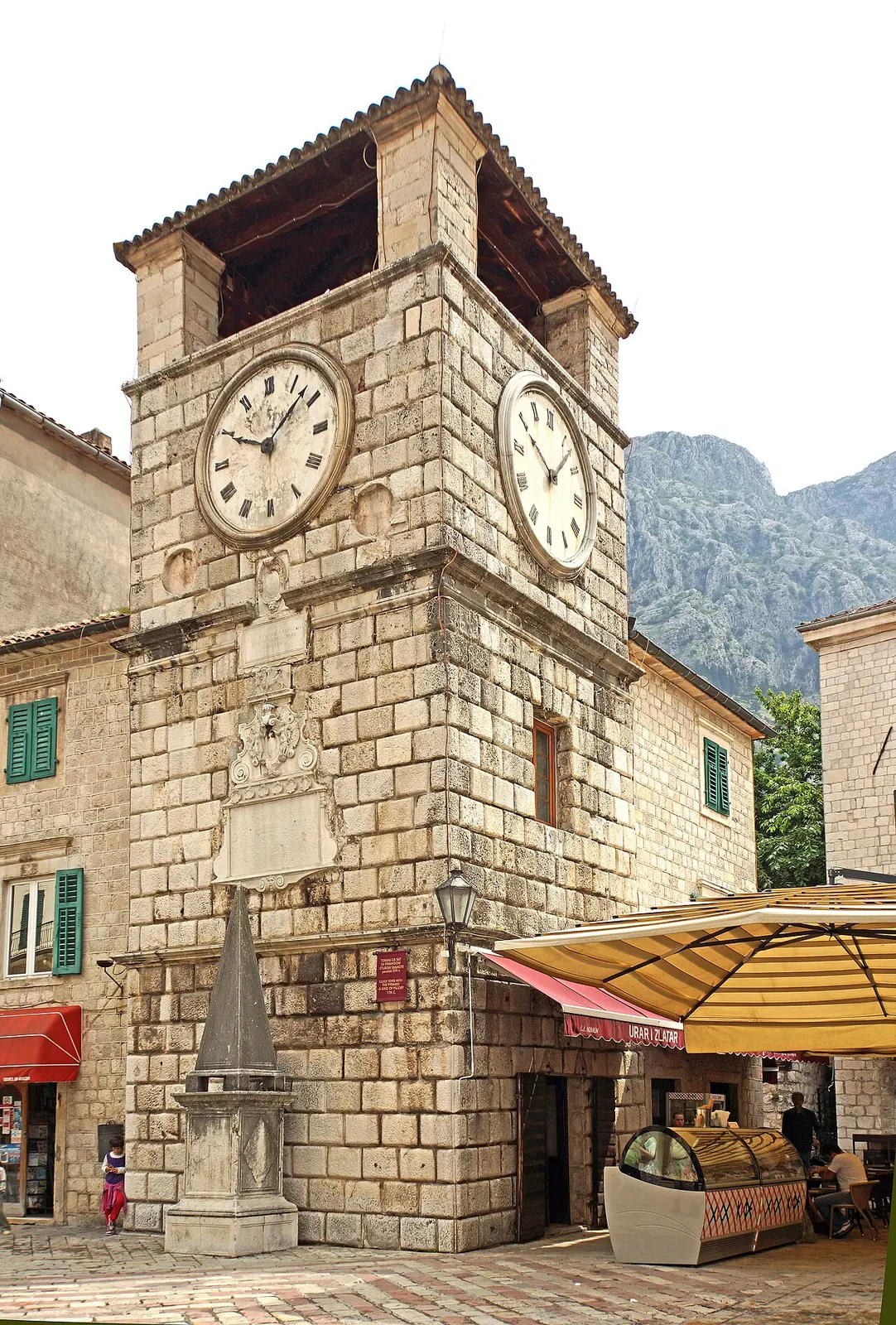
- Built in the early 1600s under Venetian rule; the clock and bell stage crown a slim stone shaft.
- The pronounced lean is a legacy of the bay's earthquakes, including 1667 and 1979 — verify current restoration access before assuming the interior is open.
- The 'pillar of shame' at the base once held offenders up to public shaming.
Map pins
Map data © OpenStreetMap contributors · Tiles © OpenFreeMap
Arms Square: Kotor's living room
Spend any time in Kotor and you will keep ending up on Arms Square. It is the town's social hub, the widest patch of open stone in a tightly packed quarter, and the cafés make the most of it — tables spread across the flagstones, the morning sun catches the western facades, and the whole square hums from the first coffee to the last glass of the evening. It is the natural place to sit and watch the town pass.
The square earned its name from the arsenal and armoury the Venetians kept here; this was where the Republic stored and repaired the weapons that defended the bay. Look around the square and you can still read its history in the buildings: the old rectors' and provveditori's residences, the theatre, and the gateways that lead deeper into the lanes. It is less a single sight than a stage set you walk straight into.
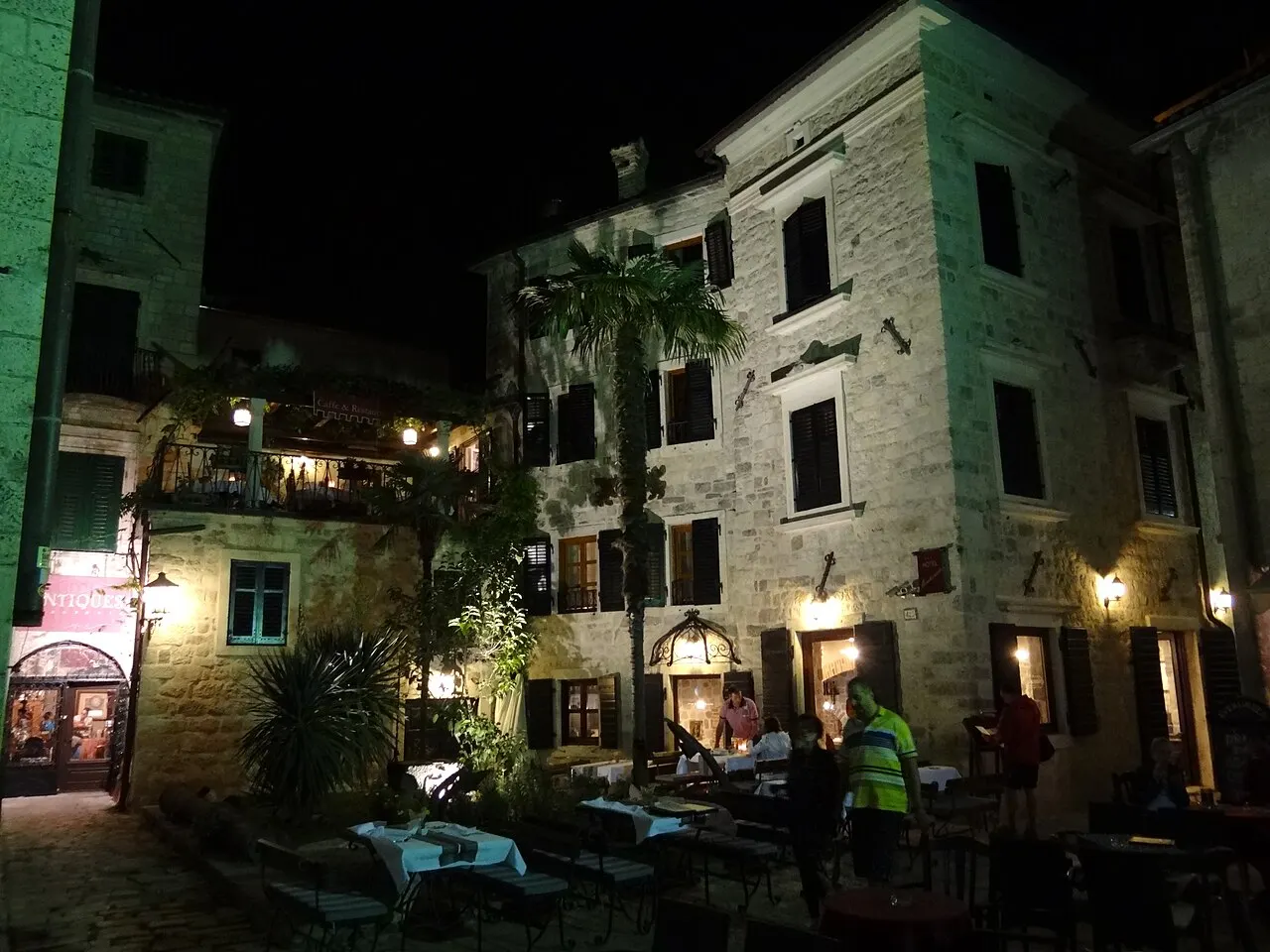
Time of day changes the square completely. On a cruise morning it fills with tour groups forming up under the clock; by mid-afternoon it can feel crowded and priced for the view. Come back in the early morning before the first ship, or late in the evening once the day-trippers have gone, and Arms Square becomes one of the most pleasant places in the whole Old Town to nurse a drink and listen to the bells.

Using the tower to find everything else
Because the tower is so central and so visible, it works best as a hub rather than a destination — the point you set out from and return to. Almost everything in the walled town is a short walk away. Head deeper in and a couple of lanes bring you to St Tryphon Square and the cathedral's twin bell towers; turn a different way for St Luke's Square with its two small churches; aim for the back of the town and you reach the gate where the climb to St John Fortress starts.
It is also the obvious meeting point. If your group splits up to wander — and in Kotor's lanes you will — 'meet at the Clock Tower' is the one instruction nobody can misread. For couples, it makes an easy romantic ritual: agree to lose each other in the lanes for an hour and reconvene under the leaning clock, drinks in hand, to compare what you each found.
Photographers should plan around the light. The square faces broadly west toward the gate, so the tower's face catches the warm late-afternoon and golden-hour light, while early mornings give you the flagstones almost empty. Either end of the day beats the flat, crowded glare of midday.
- From the tower: St Tryphon Cathedral, the Maritime Museum, St Luke's Square and the walls gate are all a few minutes on foot.
- Best meeting point in the Old Town — visible, central and unmissable.
- Best photo light: late afternoon and golden hour on the tower face; early morning for empty flagstones.
Practical notes and timing
There is no ticket to see the Clock Tower or to be on Arms Square — both are free, open public space, part of the simple pleasure of wandering the UNESCO-listed Old Town. The tower itself is not generally a place you go inside; it is a landmark you admire from the square and use to orient yourself. If you see restoration hoarding or a closed cordon, treat any 'interior open' claim with caution and verify on the day.
Fit the square into the rhythm of a good Kotor day rather than scheduling it as a stop. Start your morning here over coffee before the lanes fill, anchor your wandering on it through the day, and circle back in the evening for the lamplit version. It costs nothing, asks nothing of you, and quietly does more work than any single 'attraction' to make sense of the town.
- Free and always open — Arms Square and the tower are public space, no ticket.
- The tower is a landmark to view, not usually a building you enter; verify any interior access on the day.
- Best as your orientation hub and meeting point, visited in the cool morning and lamplit evening.


Kotor Sea Gate
Start your Old Town visit at the Sea Gate — Kotor's main western gate of 1555, opening from the waterfront onto Arms Square and the leaning clock tower. Where to find it from the cruise port, what to look for, and how to plan a route through the squares.
Read guide
Best Cafés in Kotor
Where to sit over coffee in and around Kotor: the Old Town squares for people-watching, quiet courtyards and side-lane spots, bay-view and Dobrota promenade terraces, gelato counters, rainy-day indoor rooms, and how to beat the cruise crowds to the best morning cup.
Read guide
A Self-Guided Walk Through Kotor's Old Town
A self-guided walking route through Kotor's Old Town: the Sea Gate, Arms Square and the clock tower, St Tryphon Cathedral, St Luke's and St Nicholas, the maze of palaces and the wall-view corners — in the right order, at the right hour.
Read guideMore in Old Town
4Maritime Museum of Montenegro, Kotor
Inside Kotor's Maritime Museum of Montenegro: the baroque Grgurina Palace, three floors of ships, captains' portraits, maps, weapons and Boka seafaring history — and why it is the Old Town's best rainy-day visit.
Read guide
St Luke's Church, Kotor
A guide to one of Kotor's most atmospheric small churches: St Luke's (Sveti Luka), built in 1195, famous for the rare period when it held both a Catholic and an Orthodox altar — and the quiet square it shares with St Nicholas's.
Read guide
St Nicholas's Church, Kotor
A respectful visitor guide to Kotor's main Serbian Orthodox church: St Nicholas's (Sveti Nikola), the twin-towered early-20th-century church on St Luke's Square, its glowing icons and silverwork, and how to visit.
Read guideSt Tryphon Cathedral, Kotor
How to visit Kotor's landmark Romanesque cathedral, consecrated in 1166: the twin bell towers, the treasury and the relics of St Tryphon, the art, the square, and the Old Town heritage that surrounds it.
Read guide